KUMITE RULES
1. COMPETITION GENERAL RULES
- The minimum age to participate will be 18 years. The maximum age to participate will be decided by the responsible of the championship and by the doctor of the championship after examining the competitors and before the championship starts.
- The competitors will present, before the championship starts, a signed document where the organization is exempt from responsibility in case of injury. The competitors must be assured by themselves in their Dojos and relevant organizations.
- The competitors will wear a white and clean Dogui, with the Kyokushin Kanji on the chest.
- During the fight, a competitor will wear a red identification tape (Aka), tied on the back of his/her singular, the other one will wear only his/her singular belt (shiro).
- Hands and feet nails must be cut, and metallic or similar objects may not be carried (earrings, piercings, etc.). No protective clothing, bandages, or protections may be used if they are not included in the championship regulation.
- In case of injury, the use of protective bandages will be under the absolute discretion of the Supreme Referee of the championship who will authorize it or not after consultation with the doctor.
- At first, the use of these protective bandages is not allowed until after having performed a minimum of one fight.
REFEREES AND OFFICERS
- The Referees and Officers of the championship must wear navy blue pants, white t-shirt with the WKB logo and navy-blue tie with the WKB logo. For the parade, they must wear a navy blue American jacket.
COACH
- Coaches must wear suits (optional tracksuit), and they will be seated in a chair 1.5 m from the tatami.
- The Coach will show at all times, a correct attitude and behavior. The Referee, or Tatami Judge, will watch to make it so; otherwise, he will be given a warning, and if he recurs, he will be expelled from his position on the tatami.
- In the case of being ejected again in another match, you will not be allowed to enter the competition zone.
- There can only be one coach per tatami.
- No Referee or Judge can act as Coach; if he decides to change, he cannot arbitrate again.
REGARDS
- The official salute for all, Referees, Judges, Coach, and Competitors will be the same, to the voice of OSU!, the body will be tilted at a 45º angle.
2. OFFICERS TEAM
The Officers team that forms the championship is composed of the following:
SUPREME JUDGE (Saiko Shinpan-Cho)
- The Supreme Judge has the authority to make the final decision in all the fights, decide the championship lines, and make the final decision on claims, being able to delegate his/her functions to the Referees Chief of the championship.
REFEREES CHIEF (Shinpan-Cho)
- The Referees Chief is one of the members of the reviewing panel. He/she selects the Officers Team of the championship and attends to the Supreme Judge. He/she will act as second and will assume all responsibilities in the absence of the Supreme Judge.
REFEREE (Shushin)
The referee takes control of the Tatami and supervises the Team of the four corner judges. Responsibilities include:
- Make the Referees Team enter and exit correctly from the Tatami, as well as competitors.
- Start and finish the fight.
- Maintain the composure of the fight and protect the competitors’ safety.
- Heed judges’ calls, their decisions, and show the decisions to the viewers.
- Call the judges if necessary, to consult or make decisions.
- Support and respect the decision made by the Supreme Judge, above his/her own.
3. COMPETITION AREA
- The competition area will be 8 meters from the side, plus 1 more for each side as a safety zone. You can add an area of two meters more to avoid accidents and that the referees sit on the chairs.
- The chairs of the referees will always be outside the competition area, except that the area has another meter. In that case, the referees’ chairs will be inside the tatami.
4. WEIGHT CATEGORIES
Men:
- 18+ years: -65, -70, -75, -80, -85, -90, +90
- 40+ years: -80, +80
Women:
-
18+ years: -55, -60, +65
-
40+ years: -65, +65
-
The weight tolerance to weigh them by Hikiwake is limited to 1 kg above or below the weight required in each category.
5. PROTECTIONS
- Approved protections authorized by the WKB are mandatory.
- In over 40 years category, the mandatory protections will be:
- Shin pads
- Gloves
- Chest protector (Women’s category)
- Shell (Men’s category)
- Mouthguard (optional)
6. FIGHTS DURATION
- Fights duration will be as follows: 3'00'' + 2'00'' - Weight - 2'00'' (Mandatory final decision ENCHOSEN)
- If no decision is made after two rounds, the winner will be the lighter competitor by a difference of more than 3 kg.
- If no weight difference, another fight of 2 minutes will take place with mandatory final decision (ENCHOSEN).
7. FIGHTS DECISION CRITERIA
A competitor will be declared winner before the end of the fight when he/she gets an Ippon, or two Waza-aris, which will constitute an Ippon, or if the retirement of the adversary occurs.
7.1. VICTORY BY IPPON
- Any technique in an allowable area of the body that causes the opponent to cease fighting for 3 seconds or more.
7.2. VICTORY BY WAZA-ARI
- Any technique in an allowable area of the body that causes the opponent to cease fighting for less than 3 seconds.
7.3. VICTORY BY RESIGNATION OF THE ADVERSARY (KIKEN)
- When one of the competitors voluntarily renounces to continue the fight, the other competitor will be granted victory.
7.4. VICTORY BY DECISION (HANTEI-KACHI)
The arbitration team must follow specific criteria when making final decisions:
Damage caused
Effectiveness of techniques
Variety and number of techniques used
Fight tactics and strategy (distance management, timing, focus, etc.)
Fighting spirit and perseverance during the match
A decision is valid when at least three out of the five arbitration team members reach the same conclusion. The tatami judge is responsible for recording penalties and Waza-aris to avoid confusion.
Before making the final decision, the referee will consult the judges, considering penalties and advantages, indicating:
Nothing if there is no clear difference
Waza-ari if there is a difference
Once all factors are evaluated, the arbitration team must determine whether to award victory by decision, taking into account whether either competitor has scored.
7.4.1. NEITHER COMPETITOR HAS SCORED
If neither competitor finishes the fight with an Ippon, Waza-ari, or the required reprimands, the victory will be granted by decision. To award victory based on the accumulation of penalties from the opponent, there must be a difference of at least two penalties.

7.4.2. ONE COMPETITOR HAS SCORED
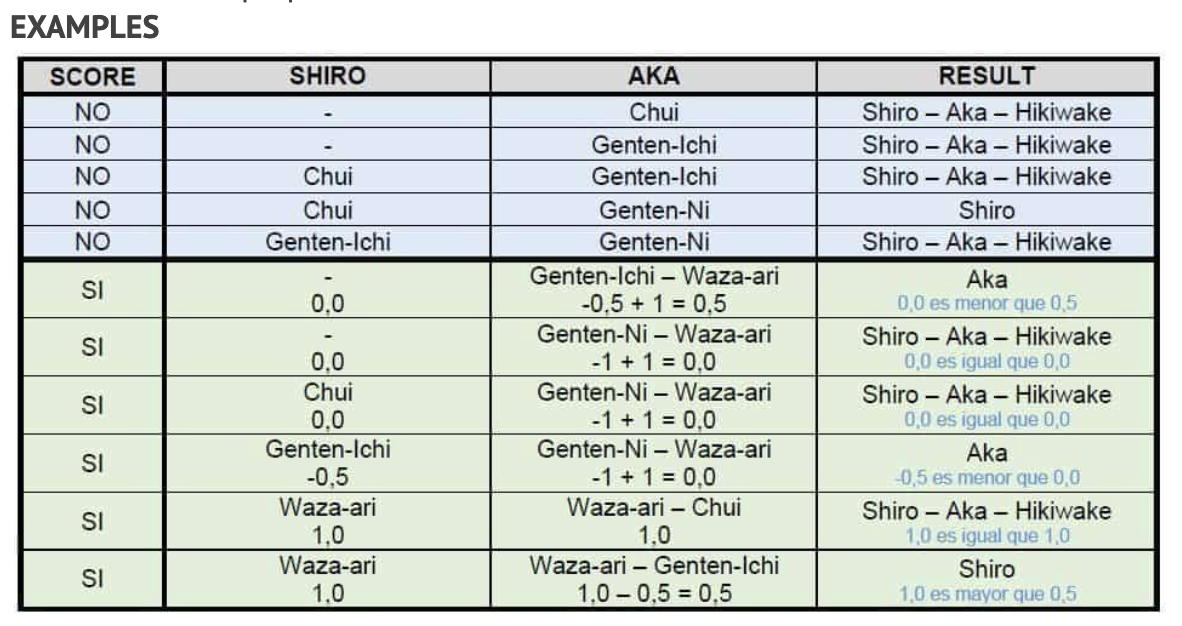
If one competitor has scored, the following equivalence between warnings, penalties, Waza-aris, and Ippons will apply:
Chui (warning) is not a penalty and holds no value for determining victory.
The competitor with the higher sum of scores and penalties will be granted victory.
8. PROHIBITED ACTS AND TECHNIQUES
The following techniques or actions are considered forbidden:
- Any attack to the head, face, or neck of the opponent with an open hand, fist, or any other part of the arm, except in special circumstances, will deserve an automatic disqualification.
- Hits to the testicles.
- Hits with the head.
- Attacking the opponent when they are on the floor.
- Any type of hit to the spine.
- Grabbing or holding an opponent by the neck or body.
- Grabbing or holding an opponent by the Dogui, arms, or legs.
- Pushing with the hands or closed fists.
- Performing an attack technique from the floor.
- Direct and frontal attacks to the knee joints.
- Stopping obeying the Referee’s instructions.
- Frequent exits from the competition area (Jogai).
- Any other technique or behavior that the arbitration team deems unfair or incorrect.
8.1. DISQUALIFICATION (SHIKKAKU)
The following issues may deserve disqualification with the complete and absolute discretion of the championship Referee. However, the disqualified competitor can show dissatisfaction through their coach to the Tatami Judge, who will review it and provide appropriate explanations. In case of doubt, it will be reviewed by the Supreme Arbitrator of the competition, whose final and permanent decision will apply.
The following situations will constitute disqualification:
- Three faults (Genten-San = Shikkaku).
- Not obeying the Referee’s instructions during the fight.
- Actions considered violent or incorrect attitudes, such as celebrating the victory when the referee gives it to the competitor. In this case, the competitor will be disqualified and will not receive a trophy.
- When competitors face each other without the desire to compete, both will be disqualified, leaving the places they would opt for vacant.
- Pretending defeat by one of the competitors.
- Competitors who refuse to participate in the kumite after three calls from the Referee.
- Physical disability that arises during the championship, allowing the competitor to retire after examination and validation of the injury by the doctor. This decision will be final.
- If a competitor is expelled in the semi-finals or finals by Shikaku, they will be without a trophy, except if for some reason the Supreme Judge after consultation decides otherwise.
- If in the final the injured competitor cannot continue the fight and does not have any Waza-ari, they will receive the second trophy. If they had a Waza-ari, they would receive the first place since they would have won.
- A competitor who has not won any combat will not have a trophy.
8.2. ORDER OF NOTICES IN FAULTS
In the committed faults by prohibited actions, the first warning will be for a mild fault and will be announced privately to the competitor:
- 1 fault …………..CHUI – admonition
- 2 faults …………..GENTEN-ICHI – penalty
- 3 faults …………..GENTEN-NI – penalty
- 4 faults …………..GENTEN-SAN – SHIKKAKU
In the committed faults by exiting the Tatami and refusing to fight:
- 1 out ……………JOGAI-CHUI – admonition
- 2 outs ……………JOGAI-GENTEN-ICHI – penalty
- 3 outs ……………JOGAI-GENTEN-NI – penalty
- 4 outs ……………JOGAI-GENTEN-SAN – SHIKKAKU
In case of Hikiwake in the fight, faults or Waza-aris will not carry over to the next extension of the fight.
9. ARBITRAL PROCEDURE AND TERMINOLOGY
9.1. ARBITRAL TEAM TATAMI ENTRY AND EXIT PROCEDURE
PROCEDURE TO ENTER
- The Referee enters first, followed by the four judges, from the right side of the front (as seen from the official table).
- Entering the Tatami, each Officer greets first when going in and then the official table, saying “OSU.”
- If there is no arbitration team in the Tatami, the incoming team goes directly to the more distant part of the Tatami, facing the official table.
- The Referee stands in the center of the Judges and slightly advanced in the line that limits the competition zone.
- The Referee gives the order of greetings: Shomen ni rei, Mawatte, Shushin ni Rei. The Judges bow the body at 45º in each order of Rei with “OSU.”
- The Judges take their assigned places in the corners.
PROCEDURE TO EXIT
- The arbitration team, after completing its turn, goes to the more distant part of the Tatami, facing the official table, and performs the greetings above.
- If not replaced, they exit the Tatami from the left side of the front (as seen from the official table), greeting the official table and then when exiting the Tatami, saying “OSU.”
9.2. PROCEDURES TO START, DIRECT AND END THE FIGHT
9.2.1. PROCEDURE TO START THE FIGHT
- Competitors enter the Tatami on their respective sides, at the same time Aka and Shiro, at the order of the Referee “Aka – Shiro, Nakai.”
- Competitors take their place looking at each other and wait for the Referee orders in Fudo Dachi.
- Referee orders:
- Shomen ni Rei ……………… Greeting to the official table
- Shushin ni Rei ……………… Greeting to the Referee
- Otagai ni Rei ……………….. Greeting between competitors
- Kamaete ……………………… Fighting position (behind the line)
- Hajime ………………………… Start the fight
10. ANNEX FOR KUMITE LOWER CATEGORIES
Lower categories follow the same regulations as the Senior category regarding evaluation criteria, reprimands, and scores, with the following exceptions:
- Fights duration:
- 8 – 9 years: 1’30’’ + 1’30’’ – weight – 1’30’’ (compulsory decision)
- 10 – 11 years: 1’30’’ + 1’30’’ – weight – 1’30’’ (compulsory decision)
- 12 – 13 years: 2’00’’ + 2’00’’ – weight – 2’00’’ (compulsory decision)
- 14 – 15 years: 2’00’’ + 2’00’’ – weight – 2’00’’ (compulsory decision)
- 16 – 17 years: 2’00’’ + 2’00’’ – weight – 2’00’’ (compulsory decision)
- Weight difference for decision: 3 kg.
- MANDATORY PROTECTIONS:
- Shin pads
- Gloves
- FULL helmet (lower categories)
- Chest protector (Women’s category)
- Mouthguard (optional)
- Shell (Men’s category)
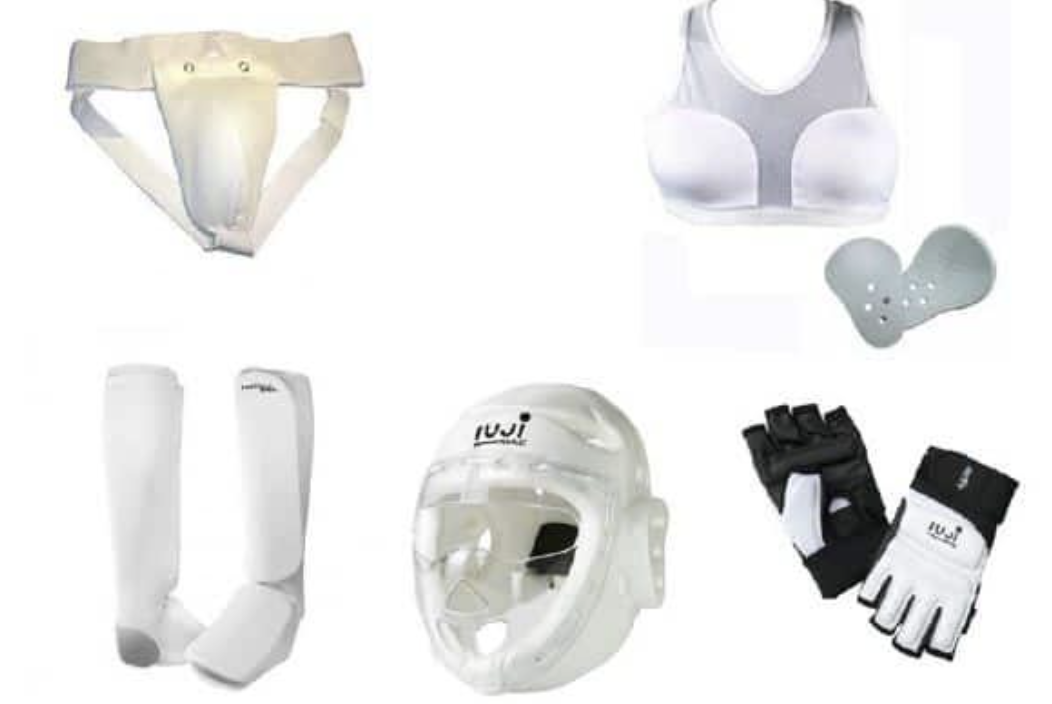
All Dojos and competitors must bring their own protections, homologated and authorized by the WKB.
The weight categories will be as follows:
Men:
- 8-9 years: -25, -30, -35, +35
- 10-11 years: -30, -35, -40, -50, +50
- 12-13 years: -40, -45, -50, -60, +60
- 14-15 years: -50, -55, -60, -70, +70
- 16-17 years: -60, -65, -70, -80, +80
Women:
- 8-9 years: -30, -35, +35
- 10-11 years: -35, -40, +40
- 12-13 years: -40, -45, -50, +50
- 14-15 years: -45, -50, -55, +55
- 16-17 years: -50, -60, +60
KATA RULES
ARTICLE 1. KATA COMPETITION AREA
- The competition area must be plain and free of obstacles.
- The competition area must be big enough to perform the complete Kata without interruption.
- For an appropriate performance of the Kata, it’s necessary a plain and stable area. Kumite tatamis are usually suitable for this.
ARTICLE 2. OFFICIAL UNIFORM
- Competitors and judges must wear WKB official uniform.
- Anyone who doesn’t comply with this regulation will be disqualified.
- During the Kata performance, the competitor cannot take off the Karate-gi jacket.
- Competitors who present themselves incorrectly dressed will have one minute to correct it.
ARTICLE 3. KATA’S COMPETITION ORGANIZATION
- Kata’s competition can be performed individually or by teams. Teams will be composed of 3 people. The team is exclusively male or female. The individual competition consists of the individual performance in separate categories for men and women.
- It can be performed any Pinan or Kata from Karate Kyokushin.
- It is allowed some variations on the Kata according to the competitor’s Kyokushin Organization, unless it is a competition only for the WKB members.
- The competitors must perform a different Kata on the 3 first rounds. From the fourth round, a Kata can be repeated as many times as the competitor decides, including the final.
- On the Kata performance by teams, the team will perform the chosen Kata as usual.
ARTICLE 4. JUDGES’ PANEL
- The panel of five judges for each match will be designated by the Judges’ Chief.
- Judges’ Chief will be seated in the centre position, in front of the competitors. The other judges will be seated in the corners of the competition area.
- Every judge will have a white and a red flag.
ARTICLE 5. EVALUATION CRITERIA
The Kata is not a dance or a theatre performance. It must keep the traditional values and principles. It must be realistic regarding the fight, and show concentration, power and potential impact during the technique’s performance.
The competitors must show strength, power and speed, as well as grace, rhythm and balance.
In Kata by team, the 3 competitors of the team must start to perform the Kata at the same direction and towards the Chief Judge and all of the team members must show the same competence in all aspects of Kata performance, as well as synchronization.
When it’s time to evaluate a competitor or a team, the judges will evaluate their performance according to four basic criteria, which are:
- Conformity
- Technical level
- Athletic level
- Technical difficulty
During the Kata evaluation, each criterion from the 4 basics will have the same importance. The Bunkai will have the same importance as the Kata.
CONFORMITY
In the form and standards of the School in question. Only if it is an exclusive WKB championship.
TECHNICAL LEVEL
The following variables will be taken into consideration:
- Positions
- Techniques
- Transitional movements
- Timing
- Control
- Concentration (Kime)
ATHLETIC LEVEL
The following variables will be taken into consideration:
- Strength
- Speed
- Balance
- Timing
TECHNICAL DIFFICULTY
The technical difficulty of the executed Kata will be taken into account as part of the valuation of the kata.
ARTICLE 5.1. DISQUALIFICATION CRITERIA
A competitor or a team can be disqualified for any of the following reasons:
- Wrong Kata performance or wrong Kata announcement.
- Unmistakable pause or detention for a few seconds during the Kata performance.
- Interference with judges’ functions (such as a judge having to move because of safety reasons or touching a judge).
- Fall of the belt during Kata performance.
- Bad behaviour or not following the instructions of the Judges’ Chief.
ARTICLE 5.2. FAULTS
According to the above criteria, the following faults have to be taken into account during the evaluation:
- A small loss of balance.
- Performing a movement incorrectly or incompletely (Greeting is considered a sign of respect and as part of the Kata movements), like failing a block or performing a punch outside the target.
- Unsynchronized movement, like performing a technique before finishing the transition of the body, or in a team case, not performing the movement with all competitors at the same time.
- Use of acoustic commands (from any other person, including other team members) or actions such as hitting the ground with the feet, slapping the chest, arms, or Karate-gi, or inadequate breathing.
- Loss of time, including extending the walking, too many greetings or long pause before starting to perform the Kata.
ARTICLE 6. MATCH OPERATIONS
- Competitors (AKA and SHIRO) align themselves on the perimeter of the competition area, greet the Judges' panel, and take turns performing their Kata.
- After the performances, judges cast their votes, and the competitor with the greater number of votes wins. Ties are not allowed.
- If a competitor or a team doesn’t show up or retires (Kiken) when called, the victory goes automatically to the opponent.
ARTICLE 7. CATEGORY & KATAS FOR ROUNDS
- 8-11 yr:
- 1st round (points): Taikioku sono san
- 2nd round (points): Pinan sono san, Pinan sono yon
- Final (flags): Kata not performed in 2nd round
- 12-13 yr:
- 1st round (points): Pinan sono ni
- 2nd round (points): Pinan sono yon, Pinan sono go
- Final (flags): Kata not performed in 2nd round
- 14-15 yr:
- 1st round (points): Pinan sono go
- 2nd round (points): Gekisai dai, Tsuki no kata
- Final (flags): Kata not performed in 2nd round
- 16-17 yr:
- 1st round (points): Tsuki no kata
- 2nd round (points): Gekisai sho, Saiha
- Final (flags): Kata not performed in 2nd round
- 18+ yr:
- 1st round (points): Gekisai sho
- 2nd round (points): Garyu, Seinchin, Seipai, Kanku Dai, Sushiho
- Final (flags): Kata not performed in 2nd round